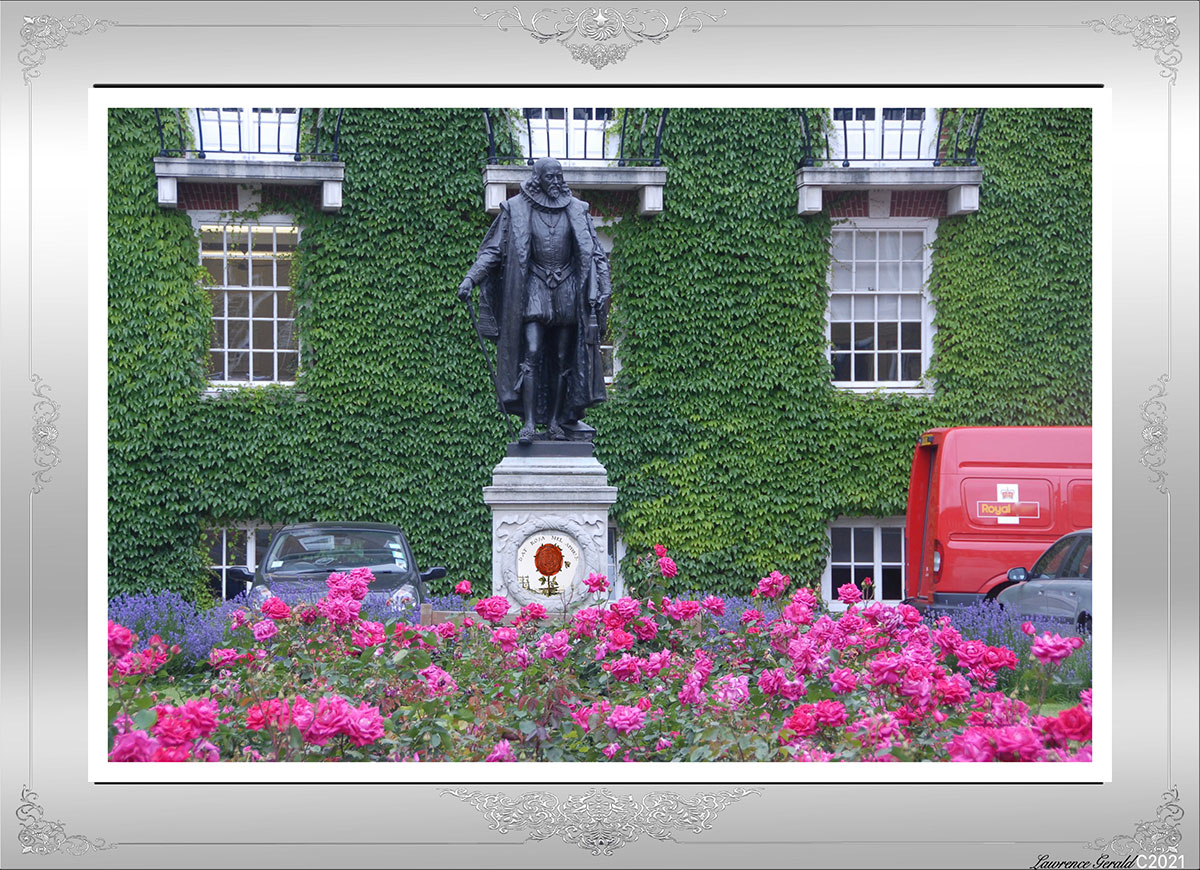
Francis Bacon-Shakespeare Founding Father of the Rosicrucian-Freemason Brotherhood and Founding Father of the United States of America

by A. Phoenix.


Sir Francis Bacon with Roses at Grays Inn

BOOK SYNOPSIS

Another diversity of Method there is, which hath some affinity with the former, used in some cases by the discretion of the ancients…that is, Enigmatical and Disclosed. The pretence whereof is to remove the vulgar capacities from being admitted to the secrets of knowledges, and to reserve them to selected auditors, or wits of such sharpness as can pierce the veil.

[James Spedding, ed., The Works of Francis Bacon, III, pp. 404-5]

That the discretion anciently observed…of publishing part, and reserving part to a private succession, and of publishing in a manner whereby it shall not be to the capacity nor taste of all, but shall as it were single and adopt his reader, is not to be laid aside, both for the avoiding of abuse in the excluded, and the strengthening of affection in the admitted.

[James Spedding, ed., The Works of Francis Bacon, III, p. 248]

The full truth about the secret birth of the New World and its concealed founder and his utopian Rosicrucian Brotherhood which laid the foundation for the most powerful republic on earth has remained hidden and obscured for the last four hundred years. To the citizens of the United States of America and the rest of the world it is fully revealed here for the first time that its true founder was the great philosopher-poet Francis Bacon, the concealed author of the Shakespeare works. It also fully reveals for the first time how the most important key figures of the American Revolution, the Baconian Benjamin Franklin, the leading Freemason of the period, President George Washington, first among all Freemasons, and the Baconian apostle President Thomas Jefferson, were all aware that Francis Bacon was the true Founding Father of the United States and carried forward his plan for the secret destiny of America.

This profound hidden secret was secretly encoded in the most powerful symbols of the United States of America: the Declaration of Independence, the US Constitution, the Great Seal and One Dollar Bill, and the US Stars and Stripes Flag, the most recognizable symbol of American power in the world today.

From the very beginning details about the great secret Francis Bacon was the Founding Father of the United States of America has been systematically supressed by American historians and his orthodox biographers and commentators. The silence and suppression commenced with his first editor and biographer Dr William Rawley, who lived with Bacon for the last ten years of his recorded life from 1616 to 1626, through the time of the early period of the first permanent English settlement in Virginia and other settlements in the New World.

So, what is the reason for this four-hundred-year secrecy, silence and suppression? Read more…>>

PDF: Book Synopsis

PDF: Full Book 561 pages

♦  ♦  ♦  ♦  ♦  ♦  ♦  ♦  ♦  ♦  ♦

Francis Bacon-Shakespeare
Founding Father of the Rosicrucian-Freemason Brotherhood
and Founding Father of the United States of America

Baconiana 2024 and Visible Remains of Sir Nicholas Bacon

by A. Phoenix.


Announcing the Publication of Baconiana 2024

The 211 page edition has over 30 contributions and a collection of many of the most recent books written about Francis Bacon, not just from a Baconian perspective but also from the areas of science, law, philosophy and politics. This is not necessarily a recommended reading list but a collection of all the latest research and thought (as well as some classics) on Francis Bacon.

We hope you find Baconiana 2024 an interesting and enjoyable read.

https://francisbaconsociety.co.uk/wp-content/uploads/2024/11/BACONIANA-2024.pdf

Announcing the Beautiful Supplement to this year’s Baconiana by Eric Roberts

Visible Remains of Sir Nicholas Bacon, The Artefacts that Preserve his Name and Legacy, The Francis Bacon Society (2024), 73 pages.

Visible Remains is a very impressive contribution to art history and the Bacon family and is a beautiful and painstakingly collated piece of work which is of great insight into the Tudor period.

Eric Roberts has liaised with all the major institutions for permissions including The Royal Collection Trust, Gray’s Inn, British Library, National Portrait Gallery, Corpus Christi, Cambridge, The Ashmolean, Cambridge University and Royal Museums Greenwich.

At first glance, it may seem that artefacts belonging to Sir Nicholas Bacon may have limited relevance or resonance to Sir Francis Bacon or to the modern world. In actual fact we all have much to owe to Sir Nicholas Bacon, Elizabeth I’s solid and wise Lord Keeper with his unswerving dedication to duty and service to both his family and to his country at a most critical period in history. Dedicated to learning, Sir Nicholas was a towering, generous statesman and a great agent for lasting change. To his family and particularly his youngest son Francis, he was a much loved and admired father, and an inspiration and role model, who contributed massively along with Lady Anne Bacon to the extraordinary man Francis Bacon became.

Visible Remains was developed from a series of research findings posted on the SirBacon.org discussion forum over many months. The project began as a series of regular newsletter articles published by the Francis Bacon Society, with the idea of collating them for this year’s Baconiana.

https://francisbaconsociety.co.uk/wp-content/uploads/2024/11/VISIBLE-REMAINS-E-BOOK-FINAL.pdf

The False And Misleading Claims By Professor Stanley Wells That Three Pieces Of Contemporary Evidence Firmly Links William Shaksper Of Stratford To Shakespeare

by A. Phoenix.


From his student graduate days Professor Stanley Wells steadily rose through the Stratfordian ranks to eventually replace his veritable hero Samuel Schoenbaum as Mr Shakespeare. Wells joined the Shakespeare Institute at Stratford in 1959 beginning his long association with the Royal Shakespeare Company, later serving as its director and vice-chairman of the governors. The Shakespeare Institute forms part of the University of Birmingham where he taught at undergraduate and graduate level allowing him to undertake research and publish his first work the Royal Shakespeare.

Read more…>>

PDF: The_False_and_Misleading_Claims_by_Profe.pdf

Sir Francis Bacon and Freemasonry article by Sally Gibbins

by Sally Gibbins,  just published  in The Square Magazine


Sir Francis Bacon and Freemasonry

www.TheSquareMagazine.com/mag/article/2024q4sir-francis-bacon-freemasonry/

The deep connections between Francis Bacon (1561-1626) and Freemasonry is hardly surprising given that Lord Bacon’s writings convey the Freemasonic principles of Love and Charity together with the four cardinal virtues of Fortitude, Prudence, Temperance and Justice that guide the life and thought of all Freemasons around the world.

Read the article on The Square Magazine

Secret Hidden References and Allusions to Bacon and the Bacon Family in the 1623 Shakespeare First Folio

by A. Phoenix.


It is true there be some affairs which require extreme secrecy.

[Francis Bacon, Of Counsel: Spedding, Works, VI, p. 425]

In addition to all the above cryptic devices secretly inserted by Bacon in the Shakespeare First Folio there are also many remarkable and astonishing references and allusions to himself and members of the Bacon family, which for four hundred years have remained unfamiliar or unknown to the ordinary schoolmen, the casual student, and effectively the rest of the world.

Read more…>>

PDF: Secret_Hidden_References_and_Allusions_t.pdf

Francis Bacon, Titus, Andronicus & Bacon’s Shakespeare Quartos Discovered at the Bacon Gorhambury Estate

by A. Phoenix.


During the period Bacon was writing his first Shakespeare tetralogy (I Henry VI, 2 Henry VI, 3 Henry VI and Richard III) he also composed his Roman history of Titus Andronicus. It has been said by many orthodox scholars that Titus Andronicus is the first of the Shakespeare plays, and whether it is actually the first, it is certainly one of the earliest. Its exact date of composition is unknown. Various dates have been suggested generally ranging from 1588 through to 1594, the date of the publication of its first quarto published under the title The Most Lamentable Romaine Tragedie of Titus Andronicus, that according to its title page was performed by three different playing companies ‘the Right Honourable the Earle of Darbie, Earl of Pembrooke, and the Earle of Sussex their Seruants’. Only one copy of the 1594 quarto is known to exist (it was first discovered in Sweden in 1904) which now resides in the Folger Shakespeare Library in Washington. A few years later, in 1909 a rare copy of the third quarto of Titus Andronicus was found among eight Shakespeare quartos at the Bacon family estate at Gorhambury most likely transferred from Bacon’s personal library in the old Gorhambury House, which were transferred for safe-keeping into the care of Bodleian Library, where they still remain to the present day.2 Could you imagine the headlines around the world if eight Shakespeare quartos were discovered in the house of Shakspere of Stratford or one of his relatives or descendants!
 

New Page: Janus Head, Bacon & Shakespeare, & Parrots

Laughing Parrots

Janus: Roman god of all beginnings represented with two faces looking in opposite directions. Janus, the Roman god of all beginnings.

Bacon: But as for imitation, it is certain that there is in men and other creatures a predisposition to imitate. We see how ready apes and monkeys are to imitate all motions of man. And besides you shall have parrots that will not only imitate voices but laughing (Slyva Sylvarum, Cent III., Exp. 236, 237)

Shakespeare: Now by two-headed Janus,
 Nature hath framed strange fellows in her time :
 Some that will evermore peep through their eyes,
 And laugh like parrots at a bagpiper. (Merchant of Venice, act.i. sc. 1.)

From: “Francis Bacon : Poet, Prophet, Philosopher Vs Phantom Captain Shakespeare, The Rosicrucian Mask” by W.F.C. Wigston

The Janus Head

Read more…>>

Follow Up on the Flawed Six Signatures of William Shakspere of Stratford

by A. Phoenix.


The British lawyer and voluminous Baconian writer Sir Edwin Durning-Lawrence who was very familiar with legal documents and wills subjected the Shakspere will and the other three signatures (the ‘signature’ in the Bellot v Mountjoy case was dealt with in his Postscriptum) to a close examination. With the permission of the Corporation of London the intrepid Durning- Lawrence arranged for the Librarian and the Chairman of the Library Committee to transfer the Purchase Deed to the British Museum to place it side by side with the Mortgage Deed:

After they had with myself and the Museum Authorities most carefully examined the two deeds, the Librarian of the City Corporation said to me, there is no reason to suppose that the Corporation deed has upon it the signature of Wm. Shakespeare, and the British Museum Authorities likewise told me that they did not think that the Museum Mortgage Deed had upon it a signature of William Shakespeare. The more you examine the whole five the more you will be certain, as the writer is, after the most careful study of the Will and of the Deeds, that not one of the five writings is a “signature,” or pretends to be a “signature,” and that therefore there is a probability, practically amounting to a certainty, that the Stratford Actor could not so much as manage to scrawl his own name.