Shakespeare was written by Sir Francis Bacon

Video by Francis Bacon Society


A video presentation by Francis Bacon members Susan Mclleroy and Briony Rawle addressing via spoken word the evidence from Constance Pott, founder of the Francis Bacon Society 1886.
 
Shakespeare was written by Sir Francis Bacon
 

‘‘What is truth?’ said jesting Pilate; and would not stay for an answer’. That was delicious! I being then about 9 years old….read that first Essay of Truth… I was thenceforward a Baconian.’ So said Constance Fearon, later Mrs Henry Pott, inspiration for the founding of the Francis Bacon Society in 1886. And when the Society became, ‘so formal and proper that it has lost all sociability’, she proceeded to found a second Bacon Society in 1905. Mrs Pott had 11 children, and in the words of one Baconiana editor: ‘she even managed to have her first born on Francis Bacon’s birthday’!

The talk encompasses a selection from Mrs Pott’s impressive output: her publication of Bacon’s Promus of Formularies and Elegancies, her books, ‘Did Francis Bacon Write Shakespeare?’, and ‘Francis Bacon and his Secret Society’, and excerpts from her private letters, papers and Baconiana articles.


David Garrick and the Rosicrucian-Freemasonic 1769 Shakespeare Stratford Jubilee

by A. Phoenix


The Shakespeare actor and Freemason David Garrick and the Rosicrucian-Freemasonic 1769 Shakespeare Stratford Jubilee

DAVID-GARRICK.pdf

In 1767 David Garrick was at epicentre of the Shakespeare world. His circle of friends covered the social and literary spectrum, among them, the Bacon editor Thomas Birch, Secretary of the Baconian-Rosicrucian-Freemasonic Royal Society, Freemason Shakespeare editors Alexander Pope and Samuel Johnson, famous men of letters including the Freemason James Boswell, the philosopher Edmund Burke, Richard Boyle, third Earl of Burlington, Philip Stanhope, Earl of Chesterfield, all Freemasons, and Benjamin Franklin, the most important American Freemason of his age.

The great Shakespeare Jubilee of 1769 organised by Shakespeare actor and Freemason David Garrick was the first Shakespeare Festival. It shone a light on the obscure borough of Stratford and set it on the road to fame and glory. The three-day festival was the key centre of interest of all England and marked the true beginning of the popularisation of Shakespeare throughout the whole world.

Read more–>>

More Than 100 Contemporary Witnesses to Francis Bacon’s Authorship

by A. Phoenix


More Than 100 Contemporary Witnesses to Francis Bacon’s Authorship of the Shakespeare Poems & Plays

Witness 1: The Earl of Southampton

More_Than_100_Contemporary_Witnesses_to.pdf

Witness 1.
Francis Bacon, the Earl of Southampton, Venus and Adonis (1593) and The Rape of Lucrece (1594), the first two works to carry the pseudonym, William Shakespeare

These writings can be classified into four categories: first, texts that Bacon wrote but not for public consumption; second, texts Bacon wrote to be circulated with his name; third, texts Bacon intended to circulate anonymously; and fourth, texts that were intended to circulate under another’s name.

[Alan Stewart with Harriet Knight, eds., The Oxford Francis Bacon: Early Writings 1584-1596 (Oxford Clarendon Press, 2012), p. xxviii]

For obvious reasons the orthodox editors and biographers of Francis Bacon and the biographers of Henry Wriothesley, Earl of Southampton have very carefully avoided placing them together even though Bacon and Southampton had a very close, intimate and complex relationship with each other from at least the late 1580s right through to the latter’s death in 1624.
Read more–>>

The Venus & Adonis Mural: An Unknown ‘Major National Treasure’

Video by A. Phoenix
Buried away in a pottery shop in St Albans is a priceless artefact, a major national treasure, a unique contemporary painting of a Shakespeare work. In 40 years from its first discovery until now there has been no extensive conservation or restoration and no media attention. Isn’t this strange, what can account for it? It’s hard to understand unless we consider that it is one more piece of strong physical evidence of Bacon’s connection to Shakespeare.

Did Francis Bacon die in 1626 or Feign his Death with the help of his Rosicrucian Brotherhood?

by A. Phoenix
A reposting on this important Essay from 2021 https://sirbacon.org/FRANCIS%20BACONS%20DEATH.pdf Video Did Francis Bacon die in 1626 or Feign his Death with the help of his Rosicrucian Brotherhood?

The Great Stratfraudian Lie

The Great Stratfraudian Lie:

More Than 100 Contemporary Witnesses to Francis Bacon’s Authorship of the Shakespeare Poems and Plays

The Stratfraudian claim that William Shakspere of Stratford was the writer of the Shakespeare poems and plays and that none of his contemporaries ever doubted this, is a demonstrable falsehood.

The ‘Witness’ book and video series presents over a hundred contemporary witnesses to Francis Bacon’s Shakespeare authorship.

The whole foundation of the fraud that William Shakspere of Stratford wrote the Shakespeare poems and plays rests upon the lie/falsehood that none of his contemporaries in the Elizabethan and Jacobean eras expressed any doubts about his authorship: never once did any whisper, even hint of it, ever leak out. In fact this lie/falsehood extends much further with a whole phalanx of orthodox Shakespeare scholars insisting not only did any of the Stratford man’s contemporaries not hint, allude to, or raise any doubts about his authorship, but none were raised for some two hundred years after his death. This fraudulent and dishonest fabrication is absolutely critical to the deception that William Shakspere wrote the Shakespeare poems and plays because it allows orthodox Shakespeare scholars to insist that the authorship question is a modern phenomenon that only took root in the second half of the nineteenth century and need not be taken seriously.

This fictitious and mendacious narrative is a demonstrable falsehood one known to some of the key institutions and orthodox Shakespeare scholars who peddle this transparent fraud. It is an attestable and provable truth that there were an enormous number of expressions of doubt about the authorship of the Shakespeare works which began literally weeks after the publication of the Shakespeare poems Venus and Adonis and The Rape of Lucrece, the first works to carry the pseudonym William Shakespeare below their dedications to the Earl of Southampton.

Yet this scarcely scratches the surface and only serves to conceal an overwhelming mountain of irrefutable evidence revealing and confirming that the great philosopher-poet Francis Bacon was the true author of the Shakespeare works, a secret known to many of his contemporaries, who repeatedly alluded, indicated and pointed to it, in their respective literary publications.

This work presents more than a hundred various witnesses to Lord Bacon’s authorship of the Shakespeare works from a wide range of different perspectives.

Full PDF:

https://www.academia.edu/128613427/The_Great_Stratfraudian_Lie

Read the PDF Introduction below the video introduction:

https://www.academia.edu/128613501/The_Great_Stratfraudian_Lie_Introduction


Table of Contents

Introduction – p. 20
 

1] Francis Bacon, the Earl of Southampton, Venus and Adonis (1593) and The Rape of Lucrece (1594), the first two works to carry the pseudonym, William Shakespeare – p. 51

2] Thomas Edwards, L’ Envoy to Narcissus (1593) revealing the name William Shakespeare in Venus and Adonis is a mask for Francis Bacon – p. 56

3] T. H., Oenone and Paris (1594) revealing the name William Shakespeare in Venus and Adonis is a mask – p. 68

4] Epicedivm, A Funerall Song… – p. 70

5] The Sonnet by Jean la Jessee… – p. 74

6] The Mural of Venus and Adonis… – p. 77

7] The Satires of Joseph Hall and John Marston… – p. 81

8] The First Shakespeare play The Troublesome Reign of King John… – pp. 109

9] Francis Bacon and The Comedy of Errors… – p. 115

10] Bacon, Henry Herbert, second Earl of Pembroke and The Pembroke’s Men… – p. 119

11] Francis Bacon and his relative Henry Carey… – p. 124

12] Francis Bacon, Anthony Bacon, Love’s Labour’s Lost and The Merchant of Venice… – p. 131

13] Francis Bacon, his cousin Sir Edward Hoby… – p. 142

14] Francis Bacon’s Private Manuscript Notebook, known as the Promus… – p. 145

15] Francis Bacon and the so-called ‘Dering Manuscript of Henry IV’… – p. 151

16] Francis Bacon and his Unique Copy of the 1587 edition of Holinshed’s Chronicles… – p. 168

17] His collection of MSS known as The Northumberland Manuscript… – p. 189

18] The Six So-Called Signatures… and ‘Hand D’… – p. 195

19] John Weever (1599)… – p. 227

20] Bacon, the Earl of Essex and Richard II… – p. 241

21] Bacon’s Letter to Sir John Davies… – p. 251

22] Hamlet (1603-4) A Tudor Family Tragedy – p. 255

23] Henry Chettle, England’s Mourning Garment (1603) – p. 261

24] The monogram of Francis Bacon in the first sonnet in the 1609 edition of Shakespeares Sonnets… – p. 266

25] John Davies of Hereford, The Scourge of Folly… – p. 269

26] The eight Shakespeare Quartos Discovered at the Bacon Gorhambury Estate… – p. 273

27] Henry Peacham, Minerva Britanna (1612) Bacon is Shakespeare – p. 275

28] Thomas Freeman, Rubbe and a Great Cast… – p. 299

29] The Historian William Camden reveals Bacon is Shakespeare (1614) – p. 303

30] The Rosicrucian manifesto Confessio Fraternitatis (1615)… – p. 306

31] The Plempii Emblem (1616)… – p. 312

32] The frontispiece to Speculum Sophicum Rhodo-Stauroticum (1618)… – p. 313

33] The Veiled and Feathered Sunburst Symbol found in Canonbury Tower… – p. 314

34] Francis Bacon and his alter-ego Sir Tobie Matthew – p. 319

35] The Extensive Revision & Amendments in the Pavier/Jaggard Shakespeare Quartos… – p. 328

36] The poet John Borough researcher for Bacon’s prose history of Henry VII… – p. 332

37] The letter from Bacon to Count Gondomar (6 June 1621)… – p. 341

38] The Baconian AA headpieces in the Shakespeare Quartos & Folios (1593-1623) – p. 347

39] Bacon and his Hidden and Obscured Relationship with Ben Jonson… – p. 380

40] Bacon and the Jaggard family, printers & publishers of the First Folio… – p. 415

41] The Shakespeare First Folio: A Baconian-Rosicrucian-Freemasonic Illusion (1623) – p. 422

42] Bacon, Martin Droeshout and the Droeshout Mask… – p. 423

43] ‘To The Reader’… by Ben Jonson (1623) – p. 456

44] ‘To the memory of my beloued, The Avthor Mr. William Shakespeare’ by Ben Jonson – p. 463

45] The Dedication to the ‘Incomparable Paire Of Brethren’… – p. 469

46] The poet George Herbert… – p. 483

47] ‘To the great Variety of Readers’ signed in the names of Heminges & Condell – p. 486

48] Bacon, Leonard Digges and the verse… – p. 488

49] Bacon, Hugh Holland and the verse… – p. 491

50] Bacon, James Mabbe and the verse… – p. 495

51] The Tempest the First Play in the First Folio: A Baconian-Rosicrucian Manifesto – p. 508

52] Hidden Baconian Acrostics & Anagrams in the Shakespeare First Folio – p. 516

53] Secret Hidden References & Allusions to Bacon and the Bacon Family… – p. 526

54] Thomas Powell, The Attourneys Academy (1623)… – p. 562

55] Title page of Cryptomenytices et Cryptographiae (1624)… – p. 566

56] The Baconian-Rosicrucian-Freemasonic Stratford Shakespeare Monument… – p. 571

57-89] Bacon, Dr Rawley and the Thirty-Two verses in the Memoriae (1626)… – p. 583

90] Lord Keeper Bishop John Williams… – p. 604

91] The diplomat Sir William Boswell… – p. 606

92] A Banquet of Jests (1630)… – p. 609

93] The verse ‘On Worthy Master Shake-speare’… – p. 612

94] The 1640 edition of Shakespeare Poems… – p. 615

95] The frontispiece of Bacon’s La Saggesse Mysterieuse… – p. 627

96] The title page of the 1642 Latin edition of The History and Reign of King Henry the Seventh… – p. 630

97] The title page of the 1641 Latin edition of Bacon’s Essays… – p. 631

98] The title page of The Prophecy of the Life, Reign and Death of William Laud… – p. 632

99] The Great Assises Holden in Parnassus by Apollo (1645)… – p. 633

100] The title page of De Augmentis Scientiarum (1645)… – p. 634

101] The title page of the rare 1655 edition of The Rape of Lucrece… – p. 635

102] His second editor Thomas Tenison, Baconiana (1679)… – p. 636

103] The Secret Life and Writings of Francis Bacon in 39 Shakespeare Poems and Plays – p. 638

References – p. 664

Francis Bacon-Shakespeare Founding Father of the Rosicrucian-Freemason Brotherhood and Founding Father of the United States of America

by A. Phoenix.
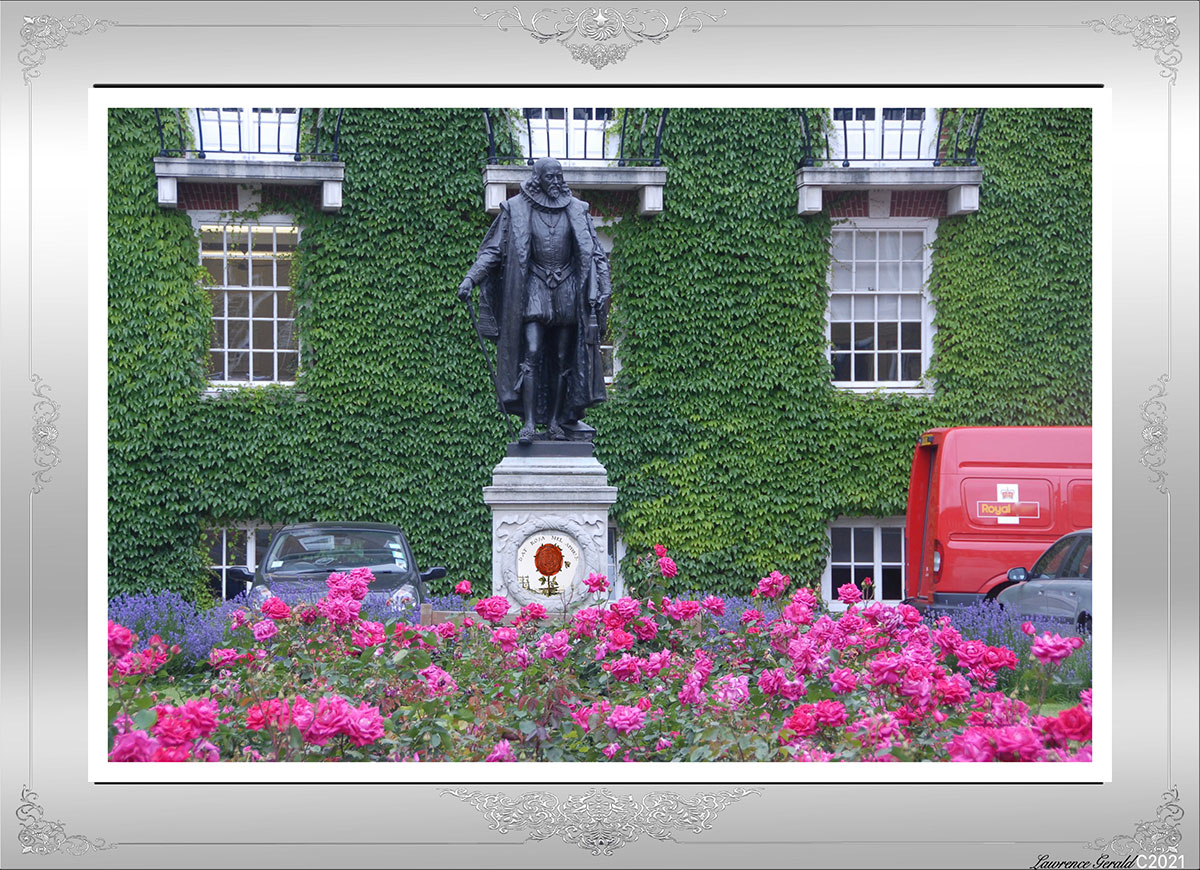

Sir Francis Bacon with Roses at Grays Inn

BOOK SYNOPSIS

Another diversity of Method there is, which hath some affinity with the former, used in some cases by the discretion of the ancients…that is, Enigmatical and Disclosed. The pretence whereof is to remove the vulgar capacities from being admitted to the secrets of knowledges, and to reserve them to selected auditors, or wits of such sharpness as can pierce the veil.

[James Spedding, ed., The Works of Francis Bacon, III, pp. 404-5]

That the discretion anciently observed…of publishing part, and reserving part to a private succession, and of publishing in a manner whereby it shall not be to the capacity nor taste of all, but shall as it were single and adopt his reader, is not to be laid aside, both for the avoiding of abuse in the excluded, and the strengthening of affection in the admitted.

[James Spedding, ed., The Works of Francis Bacon, III, p. 248]

The full truth about the secret birth of the New World and its concealed founder and his utopian Rosicrucian Brotherhood which laid the foundation for the most powerful republic on earth has remained hidden and obscured for the last four hundred years. To the citizens of the United States of America and the rest of the world it is fully revealed here for the first time that its true founder was the great philosopher-poet Francis Bacon, the concealed author of the Shakespeare works. It also fully reveals for the first time how the most important key figures of the American Revolution, the Baconian Benjamin Franklin, the leading Freemason of the period, President George Washington, first among all Freemasons, and the Baconian apostle President Thomas Jefferson, were all aware that Francis Bacon was the true Founding Father of the United States and carried forward his plan for the secret destiny of America.

This profound hidden secret was secretly encoded in the most powerful symbols of the United States of America: the Declaration of Independence, the US Constitution, the Great Seal and One Dollar Bill, and the US Stars and Stripes Flag, the most recognizable symbol of American power in the world today.

From the very beginning details about the great secret Francis Bacon was the Founding Father of the United States of America has been systematically supressed by American historians and his orthodox biographers and commentators. The silence and suppression commenced with his first editor and biographer Dr William Rawley, who lived with Bacon for the last ten years of his recorded life from 1616 to 1626, through the time of the early period of the first permanent English settlement in Virginia and other settlements in the New World.

So, what is the reason for this four-hundred-year secrecy, silence and suppression? Read more…>>

PDF: Book Synopsis

PDF: Full Book 561 pages

♦  ♦  ♦  ♦  ♦  ♦  ♦  ♦  ♦  ♦  ♦

Francis Bacon-Shakespeare
Founding Father of the Rosicrucian-Freemason Brotherhood
and Founding Father of the United States of America